

magnetic annealing
what Is magnetic annealing?
Magnetic annealing is a high-quality heat treatment that leads to recrystallization of the material and the complete removal of traces of cold deformation. The main goal is to optimize the magnetic properties of soft magnetic materials by favorably influencing their microstructure and magnetic domains.
Magnetic domains are small regions in a material where the magnetic moments of atoms are aligned in the same direction. They form because atoms create a magnetic field and influence neighboring atoms. As the material cools, the magnetic moments organize themselves, and these domains emerge. The size and shape depend on the material and external factors such as temperature or fields. This affects the magnetic properties, for example, in ferromagnetic materials.
The correct control of temperature, annealing time, cooling rate, and furnace atmosphere is crucial to achieve optimal soft magnetic properties.
magnetic annealing process
Magnetic annealing takes place above the Curie point or above the recrystallization temperature, depending on the material and desired properties. The treatment is performed under vacuum to prevent oxidation and contamination.
After treatment, any form of mechanical shock, deformation, or cold working should be avoided, as these can again impair the improved magnetic properties.
applications & materials
This process is mainly applied to soft ferromagnetic materials such as:
- pure iron (Magnet iron, RFE 80 and 100)
- nickel alloys (Mu metal, RNi2, RNi5)
- nickel-iron (FeNi48)
- cobalt-iron (FeCo49V2)
- silicon steel
- ferritic and martensitic stainless steel
Although the effects are more limited in low-carbon steel, this material can also benefit from the treatment. Austenitic stainless steel (AISI 304/316 etc.) is also often magnetically annealed to eliminate magnetism caused by processing.
The treated parts are used as field enhancers (magnetic cores) or field channels (magnetic shielding) in high-tech applications such as electron microscopes, connectors, aerospace (sensors, etc.), and many other semiconductor applications (relays, solenoids). In short, all parts that require high permeability or low coercivity.
purpose and effects
Magnetic annealing is applied to:
- Remove internal stresses
Mechanical operations such as machining, forming, or cold rolling cause internal stresses and dislocations that deteriorate magnetic properties. Magnetic annealing eliminates these stresses and crystal lattice defects. - Optimize magnetic properties
Through recrystallization and controlled grain growth, magnetic permeability increases and coercive force (the field strength required to demagnetize the material) decreases.
why magnetic annealing at Aalberts Surface Technologies Eindhoven BV?
As previously mentioned, the correct control of temperature, annealing time, cooling rate, and furnace atmosphere is crucial to achieve optimal soft magnetic properties. As early as the 1980s, we developed special processes with users such as ThermoFischer for most metals and documented them in a so-called MFV (machine factory specification). We also develop custom processes for the latest materials.
Critical parts may still be post-processed to a limited extent after annealing. Larger parts are often first stress-relief annealed after rough pre-processing, also tailored to the specific material.
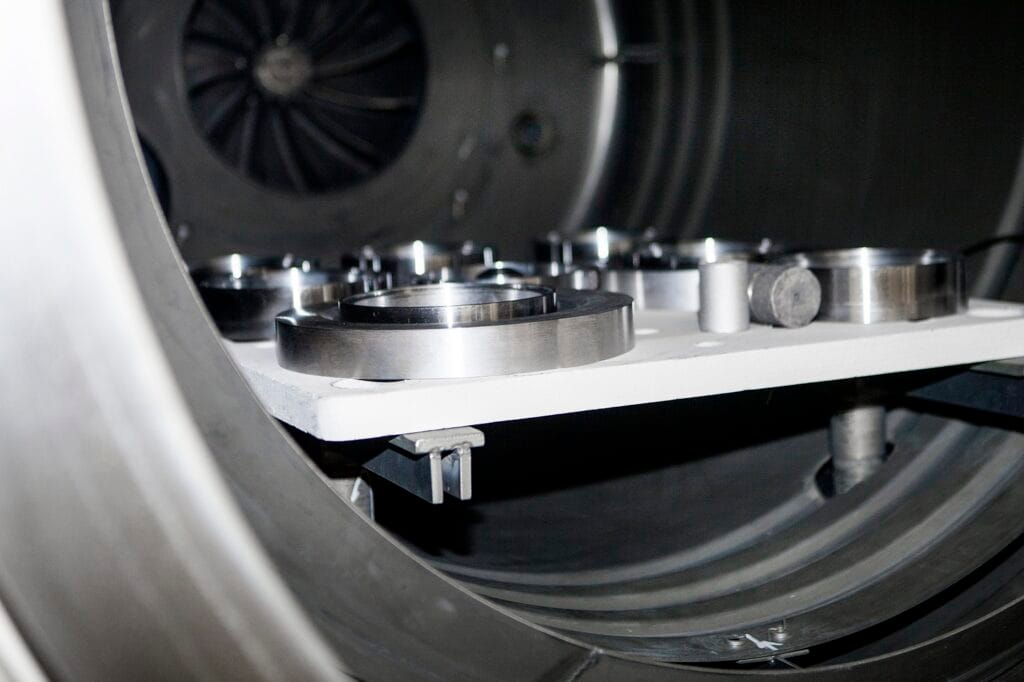
Special vacuum furnaces are used for magnetic annealing. Our vacuum furnaces are also used for aerospace, ensuring optimal temperature accuracy and very clean conditions. Annealing under hydrogen is also possible, but we see that the added value is limited.
Not only is the process important, but also the method of loading is critical.
frequently asked questions about magnetic annealing
Which metals are magnetically annealed?
This process is mainly applied to soft ferromagnetic materials such as pure iron (magnetic iron, RFE 80 and 100), nickel alloys (Mu metal, RNi2, RNi5), nickel iron (FeNi48), cobalt iron (FeCo49V2), silicon steel, ferritic and martensitic stainless steel.
Although the effects are more limited in low-carbon steel, this material can also benefit from the treatment. Austenitic stainless steel (AISI 304/316, etc.) is also often magnetically annealed to eliminate magnetism caused by processing.
Why choose magnetic annealing at Aalberts Surface Technologies Eindhoven BV?
The correct control of temperature, annealing time, cooling rate, and furnace atmosphere is crucial to obtain optimal soft magnetic properties.
Back in the 1980s, we worked with users such as ThermoFischer to develop special processes for most metals and documented (secured) them in a so-called MFV (machine factory specification).
We are also continuously developing customized processes for the latest materials.
process locations
Any questions? Contact us directly or select a process location near you.
