

hot isostatic pressing
what is Hot Isostatic Pressing (HIP)?
Hot Isostatic Pressing, commonly known as HIP, is a manufacturing process that combines the use of high-pressure inert gas with elevated temperatures. The pressure applied in this process is isostatic, meaning it is uniformly distributed in all directions through the inert gas. This unique environment of heat and pressure closes pores and defects that form when parts are cast or additively manufactured, bringing the parts as close as possible to their maximum theoretical density, enhancing product safety, and improving product performance.
process information
HIP uses a furnace inside a pressure vessel and is the simultaneous application of heat and a high-pressure inert gas (usually Argon) to materials. The simultaneous application of heat (up to 1250 °C) and pressure (up to 200 MPa, 2000 bar) eliminates internal voids and microporosity (no connectivity to the surface) through a combination of plastic deformation, creep, and diffusion bonding. The furnace chamber is heated, causing the pressure inside the vessel to increase. Many systems use associated gas pumping to achieve the high pressure level. The gas pressure is applied to the material from all directions (hence the term “isostatic”).
fields of application of HIP
Hot Isostatic Pressing (HIP) significantly increases the chances of success in mission-critical, high-risk applications such as aerospace, defense, energy, nuclear power, and orthopedic implants. HIP is a versatile method that can be used on a range of materials and manufacturing techniques. It is suitable for improving castings and parts produced through additive manufacturing. In addition, HIP is employed to consolidate powder metallurgy materials into components that are fully dense. The process is also effective for bonding dissimilar materials together.
advantages of HIP
One of the primary advantages of HIP is the removal of porosity, which results in superior mechanical properties for treated components. This process also leads to a reduction in the variability of mechanical properties, particularly important for mission-critical parts such as turbine blades, medical implants, and rocket engines. By enhancing the consistency and reliability of these parts, HIP plays a vital role in their performance and safety.
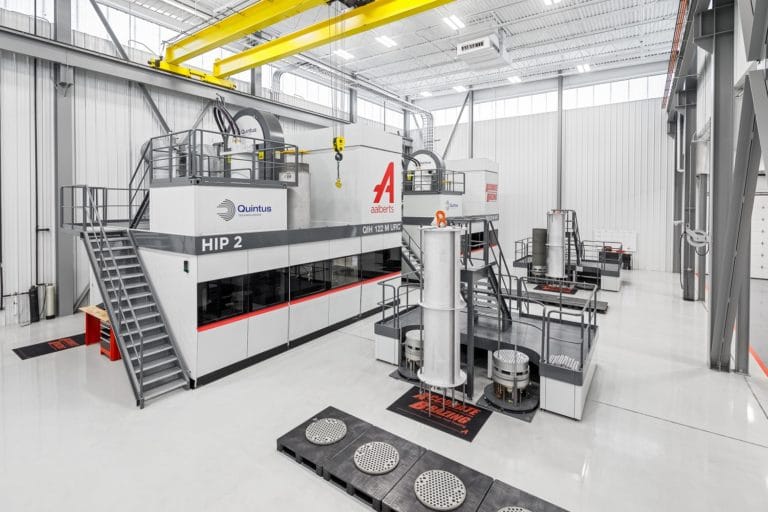
The press, model QIH 122 M URC®, is equipped with Quintus’ proprietary uniform rapid cooling (URC), a feature that improves material properties of parts designed for mission-critical applications, increasingly produced in the vibrant additive manufacturing (AM) environment.
results
HIP improves mechanical properties such as fatigue resistance, creep, ductility, and workability of parts designed for mission-critical applications. The HIP process densifies, repairs, and creates a uniform microstructure and is the ideal process to improve the reliability and performance of your product by eliminating porosity and achieving 100% theoretical density. By enhancing the consistency and reliability of these parts, HIP plays a vital role in their performance and safety.
Proven benefits are:
- Superior material properties (fatigue strength, creep strength, tensile ductility, and fracture toughness)
- Reduced property scatter (as-cast, as-built)
- Improved machined & polished surface
- Low-weight design
- No internal defects (reduction of casting rejection rate and inspection costs)
- Lower production cost
materials and products that can be treated
Application | Goal | Material |
Densification of (investment) castings and |
| Ni- and Co-based superalloys |
Densification of pre-sintered powders |
| WC hard metals |
Consolidations of encapsulated powders |
| HSS steels |
Interface bonding |
| Bronze and steel |
Specialized applications |
| ZnS |

HIP Process - casting repair:
A HIP unit consists of a high temperature furnace enclosed within a pressure vessel. Castings or Powdered Metals are placed in a CAN (the work pieces) and heated under a uniform, isostatic pressure of inert Argon gas. This process repairs castings that have both visible and invisible adverse properties. Following Hipping, the result is elimination of internal voids (i.e. porosity) and improved microstructure. Any voids in the casting will repaired by this process.
If you seek to repair your casting, the HIP process is the route to do it. If you have critically important cast parts and require certainty of performance (e.g. for the links used in helicopter power trains) then your casting process should be completed using HIPping. This will ensure that there are no invisible, weak areas within your component.
HIP is effective with almost all materials – including metals, ceramics and plastics. HIP repaired castings have all the porosity removed. The reduced porosity of HIP’ed materials enables improved mechanical properties such as fatigue strength and increased workability. The HIP process densifies and repairs and creates a clean uniform microstructure of the casting. Examination of HIPPED parts by nondestructive testing techniques show excellent results. These characteristics are not possible with welding or casting.
powder metallurgy using HIPPING
In Powder Metallurgy, the HIP process can produce materials from metallic compositions that are difficult or impossible to forge or cast.
We recommend that a container is used – they are generally called “Cans” that hold the forming material and the powdered metal or alloy. Using this process, we deliver Near Net Shape for clients, which has many similarities with 3D printing, and lost wax manufacture.
As our approach uses high temperature furnace, gas environment, and high pressure, our clients are able to avoid significant post HIP operations.
Applications:
- Removal of porosity in castings
- Consolidation of encapsulated powders to near-net shape forming
- Densification of MMC’s and Ceramics
- Advanced diffusion bonding techniques (cladding)
certifications
Aalbert’s HIP facilities hold:
- Standard quality and environmental accreditations.
- Nadcap, the leading accreditation for special processes within the aerospace industry.
- Many relevant OEM approvals, such as GE Aerospace, Safran, SpaceX, to name a few.
Please reach out for further details.
safety, environment, and sustainability
Our special process improves safety, component performance, and lower emissions. We prioritize service, quality, and sustainability, realizing social and environmental impact in our customers’ end markets. We strive for zero harm and best environmental practices by focusing on culture, leadership, technology, and responsibility. Aalberts has earned bronze, silver, and gold medals across the group, showing our commitment to sustainability.
industries we serve

frequently asked questions
why are HIP suitable for the aerospace industry?
Removing the porosity up to theoretical 100%
downloads
process locations
Any questions? Contact us directly or select a process location near you.
Eindhoven
the Netherlands 51.47035245.419001 info.eindhoven-heat@aalberts-st.com +31 40 266 3000 show locationGreenville (South Carolina)
United States 34.8319956-82.2940535 HT-AST-Garlington@aalberts-st.us (864) 213-9310 show locationCleveland
United States 41.6349254-81.4225348 sales@paulo.com +1 440 946 5900 show locationUnsere Verfahren
Wir bieten weltweit alle Arten von Wärmebehandlungsprozessen an. Unsere Anlagen sind logistisch eng miteinander verknüpft, so dass Ihnen alle Verfahren zur Verfügung stehen. Erfahren Sie mehr zu unseren Wärmebehandlungsverfahren.
Heiß-Isostatisches Pressen (HIP) dient der Beseitigung von Porosität. Sie benötigen bei Lötverbindungen eine hohe mechanische Haltbarkeit und Unempfindlichkeit bei hohen Temperaturen? Wir bei Aalberts surface technologies bieten die Lösung durch Hartlöten (brazing).
Polymerbeschichtungen können auf viele Grundmaterialien aufgebracht werden und bieten lang anhaltenden Schutz. Sie sind mechanisch besonders gut mit dem Untergrund verankert und bieten verbesserte Gleiteigenschaften und/oder hohe Verschleißfestigkeit.
Mit 40 Jahren Erfahrung in der kontinuierlichen Veredelung von reel to reel können Sie sich auf Aalberts surface technologies verlassen, um innovative Lösungen zu finden. Unser Service umfasst Trommelgalvanik, kontinuierliche selektive Galvanik und Gestellgalvanik.
Fast alle metallischen Grundwerkstoffe können mit unseren selbstentwickelten und patentierten Verfahren durch Oberflächenbeschichtungen in ihren Eigenschaften optimiert werden, egal ob sie besonders hart, glatt, verschleißfest oder korrosionsbeständig sein sollen.

Discover our services
We offer all types of heat treatment processes. Our facilities are closely interlinked in terms of logistics, which means that all processes are available to you. For a complete list and description of heat treatment technologies please select the button.
Hot isostatic pressing (HIP) is used to eliminate porosity. Do you need high mechanical durability and insensitivity to high temperatures for solder joints? We at Aalberts surface technologies offer the solution through brazing.
Polymer coatings can be applied to a wide variety of base materials and offer long-lasting protection. They are particularly well anchored mechanically to the substrate. Additional enhancement layers allow non-stick coatings to be combined with improved sliding properties and/or high wear resistance.
With 40 years of experience in continuous reel to reel finishing, you can depend on Aalberts surface technologies to find innovative solutions that other companies might say are impossible. Our service includes barrel plating, continuous selective plating and rack plating.
Almost all metallic base materials can have their properties optimised by surface coatings using our proprietary and patented processes, regardless of whether they should be particularly hard, smooth, wear-resistant or corrosion-resistant.
The Aalberts websites use cookies (read more) to analyse website usage and improve usability. We also use third party tracking-cookies to measure user preferences, enable content sharing on social media and interest-based advertising. If you hit 'accept' you allow to us to place the different types of cookies.
privacy overview
| Cookie | Duration | Description |
|---|---|---|
| cookielawinfo-checkbox-analytics | 1 year | This cookies is set by GDPR Cookie Consent WordPress Plugin. The cookie is used to remember the user consent for the cookies under the category "Analytics". |
| cookielawinfo-checkbox-necessary | 1 year | This cookie is set by GDPR Cookie Consent plugin. The cookies is used to store the user consent for the cookies in the category "Necessary". |
| cookielawinfo-checkbox-others | 1 year | This cookie is set by GDPR Cookie Consent plugin. The cookie is used to store the user consent for the cookies in the category "Others". |
| cookielawinfo-checkbox-performance | 1 year | This cookie is set by GDPR Cookie Consent plugin. The cookie is used to store the user consent for the cookies in the category "Performance". |
| elementor | never | This cookie is used by the website's WordPress theme. It allows the website owner to implement or change the website's content in real-time. |
| Cookie | Duration | Description |
|---|---|---|
| cookielawinfo-checkbox-functional | 1 year | The cookie is set by GDPR cookie consent to record the user consent for the cookies in the category "Functional". |