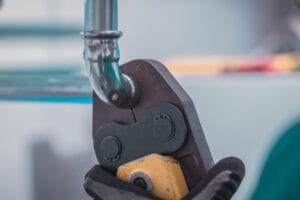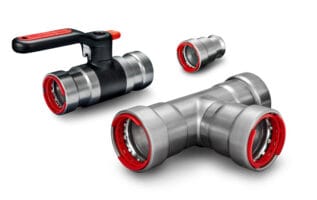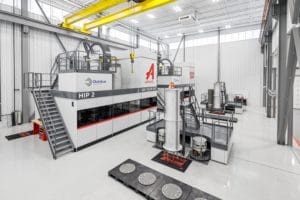
continuous furnace annealing and brazing for VSH press fittings
Aalberts Surface Technologies Venlo anneals and brazes the cold-formed metal components of VSH press fittings for Aalberts Integrated Piping Systems. Cleaning, brazing and recrystallisation annealing run as one controlled process flow in continuous furnaces. Aalberts Integrated Piping Systems gains ductile, stress-relieved parts, reproducible leak-tight joints, full batch traceability and one qualified heat treatment supplier instead of several.
key takeaways
- Recrystallisation annealing restores ductility lost during cold forming
- Controlled atmosphere brazing in a continuous furnace requires no flux
- The controlled atmosphere ensures a bright and shine surface condition of the parts
- Furnace zones have outstanding uniformity and accuracy, classified to AMS2750 and CQI-9
- Quality is verified by Vickers hardness testing to ISO 6507-1 and destructive cross-section analysis
at a glance
Customer | Aalberts Integrated Piping Systems (VSH) |
Industry | Piping systems |
Components | Metal components of VSH press and compression fittings |
Processes | Cleaning, recrystallisation and stress relief annealing, controlled atmosphere brazing |
Site | Aalberts Surface Technologies Venlo, heat treatment |
the challenge: cold forming leaves stress in the material
The metal components of VSH press fittings are produced at the Hilversum facility of Aalberts Integrated Piping Systems. Deep drawing, pressing and bending leave deformed, elongated grains and residual stress in the material. Hardness rises, ductility falls, and further cold forming becomes impossible without intermediate heat treatment. A press fitting must nevertheless remain dimensionally stable and permanently leak-tight once installed in a building. Splitting cleaning, assembly, brazing and heat treatment across separate suppliers multiplies transport movements, administration and quality risk.
the solution: one controlled process flow in Venlo
Aalberts Surface Technologies Venlo defines and validates a process for every part number, starting from the drawings of Aalberts Integrated Piping Systems.
Cleaning comes first. Alkaline and vapour degreasing remove grease and other contamination that would otherwise react in the furnace and block braze alloy flow and contaminate the surface.
Fit determines the joint. Brazed assemblies consist of two or more parts. The fit must be neither too loose nor too tight, otherwise the filler metal cannot draw evenly through the joint. Each component is degreased individually before the components are assembled and the braze alloy is applied.
Atmosphere and temperature are controlled per zone. The continuous furnaces are over 30 metres long and held above 800 °C. Type S platinum-rhodium thermocouples keep each zone accurate to better than 3°C.
Parameters are fixed and validated. Duration, temperature, atmosphere, positioning, jigging and cooling rate. Every part on the mesh belt receives identical treatment, unlike batch furnaces, where position within the load changes the result.
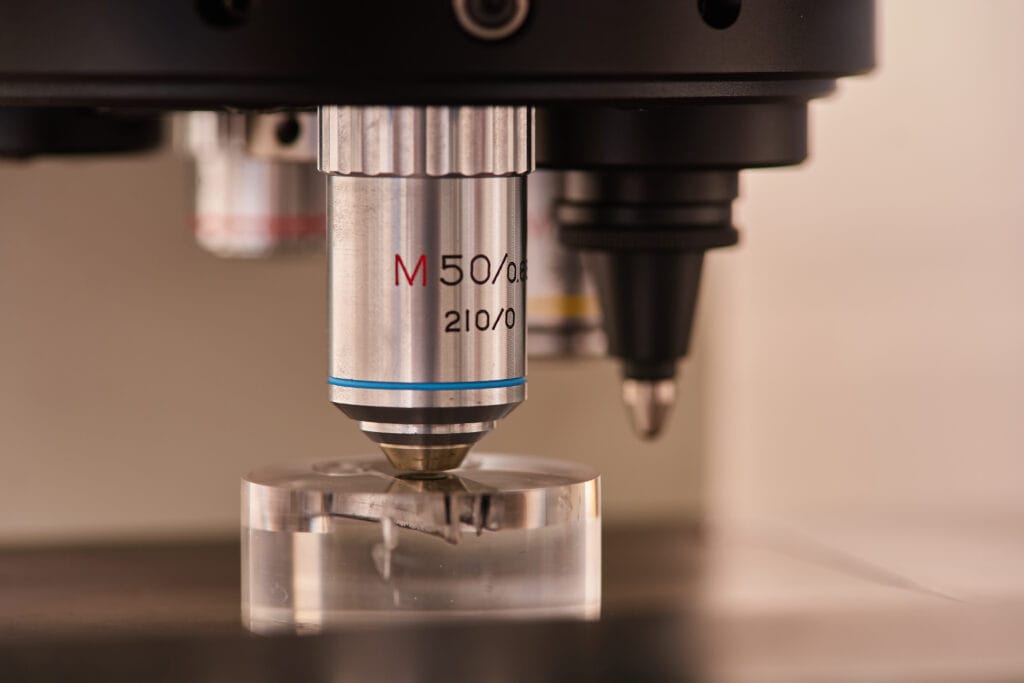
Results are proven, not assumed. Vickers hardness to ISO 6507-1 and etched cross-sections assessed for microstructure and grain size, reported digitally with the work order.
the benefit for Aalberts Integrated Piping Systems
- Ductility and formability restored for the next production step
- Residual stress removed, dimensional stability improved
- Identical microstructure across high-volume series
- Improved corrosion resistance
- Improved and bright surface conditions enables post plating without pickling.
- Reproducible leak-tight brazed joints, 100% tested where specified
- One supplier for cleaning, assembly, brazing and annealing
- Components often on their way after one day in Venlo
- 3,800 MJ and 242 kg CO₂ per tonne, against 5,700 MJ and 364 kg in a vacuum furnace
beyond piping systems
The same continuous furnace capability serves automotive, semiconductor, tooling, mechanical engineering, food and medical applications, for low-alloy and high-alloy steels, stainless steel, cast iron and non-ferrous metals.
faq
What is annealing?
Annealing heats metal above its recrystallisation temperature, holds it for a defined soaking time and cools it under control. It recrystallises the microstructure, increases ductility and reduces hardness.
Why are press fittings annealed after cold forming?
Cold forming leaves elongated grains and residual stress. Recrystallisation annealing softens the material, eliminates stress and improves corrosion resistance.
Why a continuous furnace instead of a batch furnace?
Each part travels the same belt through the same zones, receiving identical time, temperature and atmosphere. Energy use per tonne is also significantly lower.
How is annealing quality verified?
Through Vickers hardness measurement calculated to ISO 6507-1 and destructive testing of polished, etched cross-sections under a light microscope.
Can annealing and brazing be combined?
Yes. Assembled components are brazed during the annealing cycle with copper or nickel filler, without flux, cutting cost, lead time and emissions.
talk to our heat treatment specialists
Aalberts Surface Technologies Venlo advises on material selection, braze filler and process design from the first feasibility study onwards. Contact us to discuss annealing and brazing for your components.